Backrooms
Encountering unsettling spaces
I bought a new shampoo; it's been reminding me I need to call my mum, who I love and still will not call. The chemists are sold out of vitamin D and neti-pots-of-Moderna (Flo sinus care wash bottles), and yesterday's insomnia had me waking up in a swimsuit. It's SADD season.
My antidote to a weird morning followed by hours of thrumming monitor screen was to take my tension headache to Westgarth and watch lingering shots of office lighting on a screen bigger than my bedroom wall.
Backrooms was hell; it made me nauseous and I walked out feeling empty and unsettled. I hold no affinity for the characters, the narrative arc, or whatever the fuck the diabolus ex machina ending was. What vacuum-sealed my stomach to my spine, disturbing me mentally and physically, was the production design.
The Backrooms are introduced with a Dutch-angle-rich chase filmed on a Funniest Home Videos-era camcorder. We see office paraphernalia, ad banners, a dead seagull, and the occasional nest of chairs. I'm unsure if the number of chairs was genuinely in excess, or if I’m just still chair-pilled from Melbourne Design Week. The scene is saturated in yellow, shades ranging from fresh and buttery to hazmat to something adjacent to the drab khaki on Australia's [legal] cigarette packets.
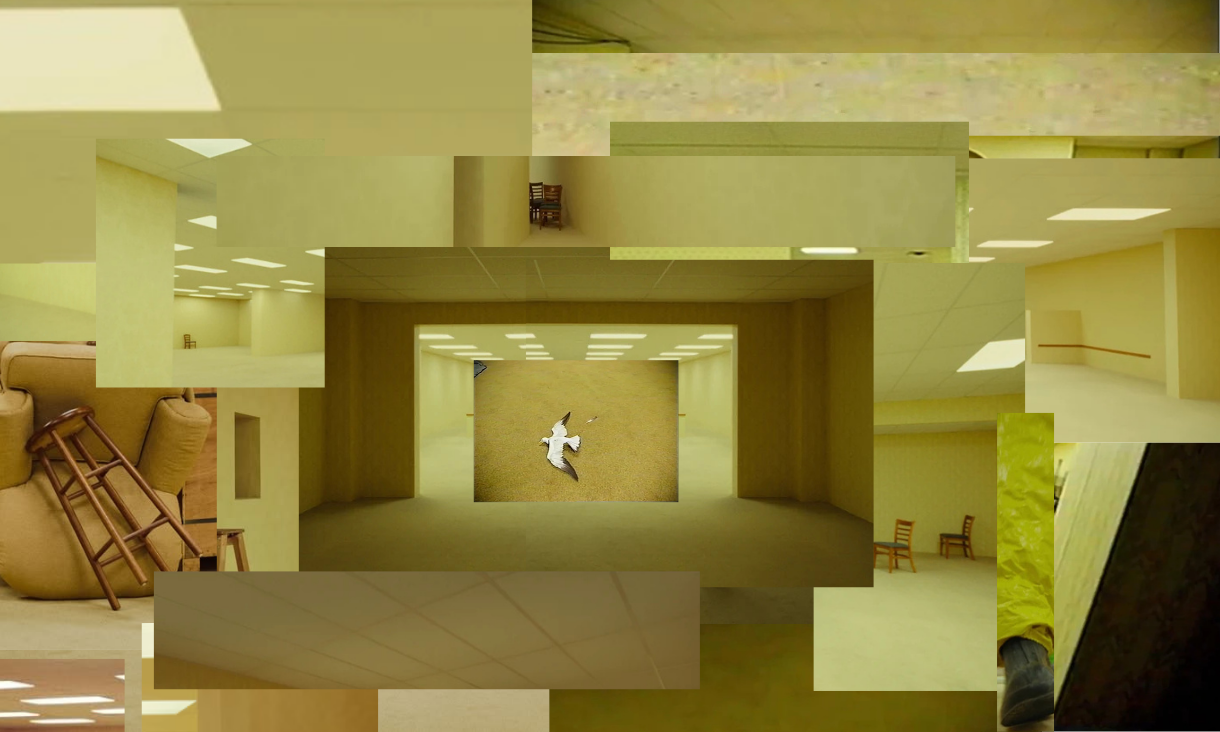
The concept for the movie (and earlier web series) was pulled from 4chan; I didn't know this until afterwards. Regardless, the early-ish internet influences bled through. Long-filed-away memories from the [pre] formative Tumblr days surged.
The laggy visuals, flashes of liminal space, and a cacophony of visual references created such gritty nostalgia that I felt uncomfortable at the amount of drippy internet my brain had soaked up. Only snapping out when the more trad moments of horror appeared, gore began to feel cathartic. What had I missed out on? What would have replaced it? Did I skip a frozen-bra-sleepover-experience because instead, we were gathered around a grey monitor, trying to decipher what was going on under the sheets during WooHoo? Who knows. When thinking about a quintessential teenage experience, the frozen bra thing was the first that came to mind. No one I know has done this, I don’t even understand the mechanics of it. It’s ripped straight from Sleepover (2004). Even in imagination, my screenless experiences have been sanded by blue light. Anemoia aside, there is also a grotesque satisfaction in having experienced the Wild West internet before complete enshittification. I was there. Kind of. I missed out on internet cafes, but, is it punk to be traumatised by Budd Dwyer? [no].
The non-backroom locations in the film reference an era of brown, 80s/90s Americana that I didn’t grow up with but still recognise. You may also find it familiar if you spent time in a budget motel in the 2000s, or if you’ve recently driven into one of the retail parks behind highway slipstreams (referring to the Officeworks, Petstock, autoshop, furniture store, fast-food-chain collective).
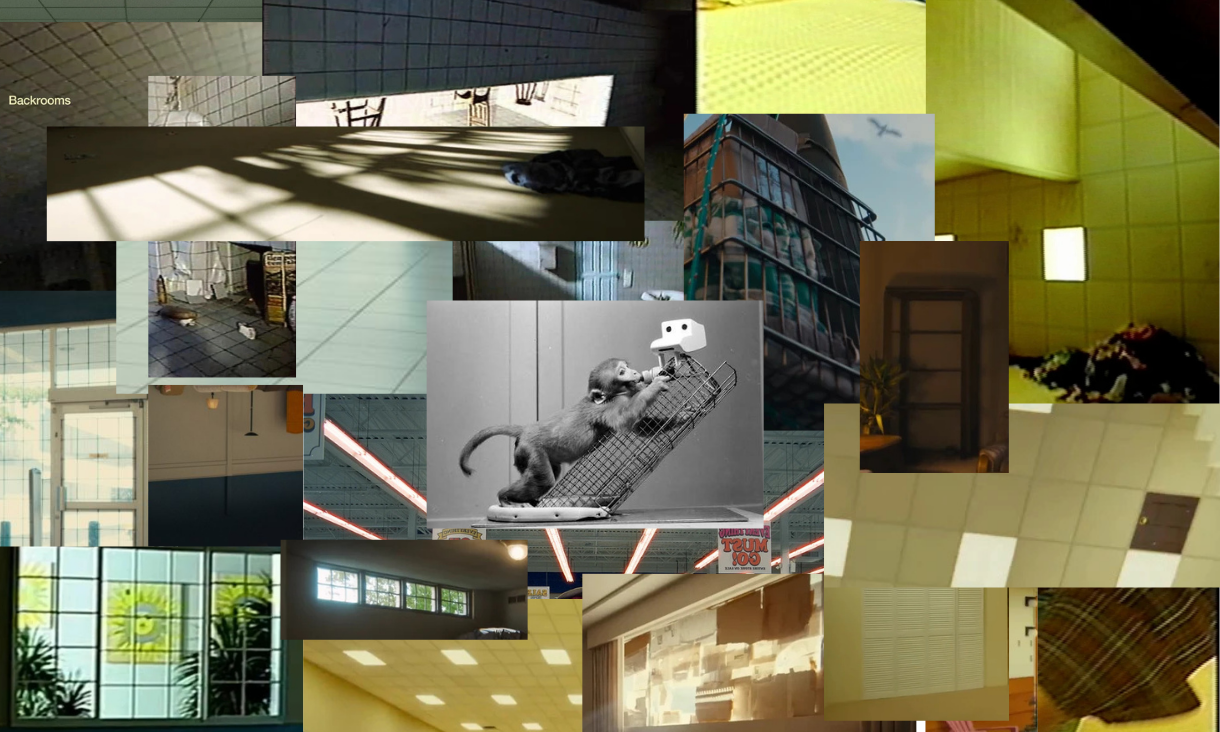
A subtle (until you notice) peppering of grid patterns also appears throughout the film. On ties, couches, ceilings, curtains, clothes, and floors. A disconcerting world constructed atop The Wire Mother from Harlow’s metal monkey experiment. It evoked the banal dread felt whenever anyone mentions the metaverse.
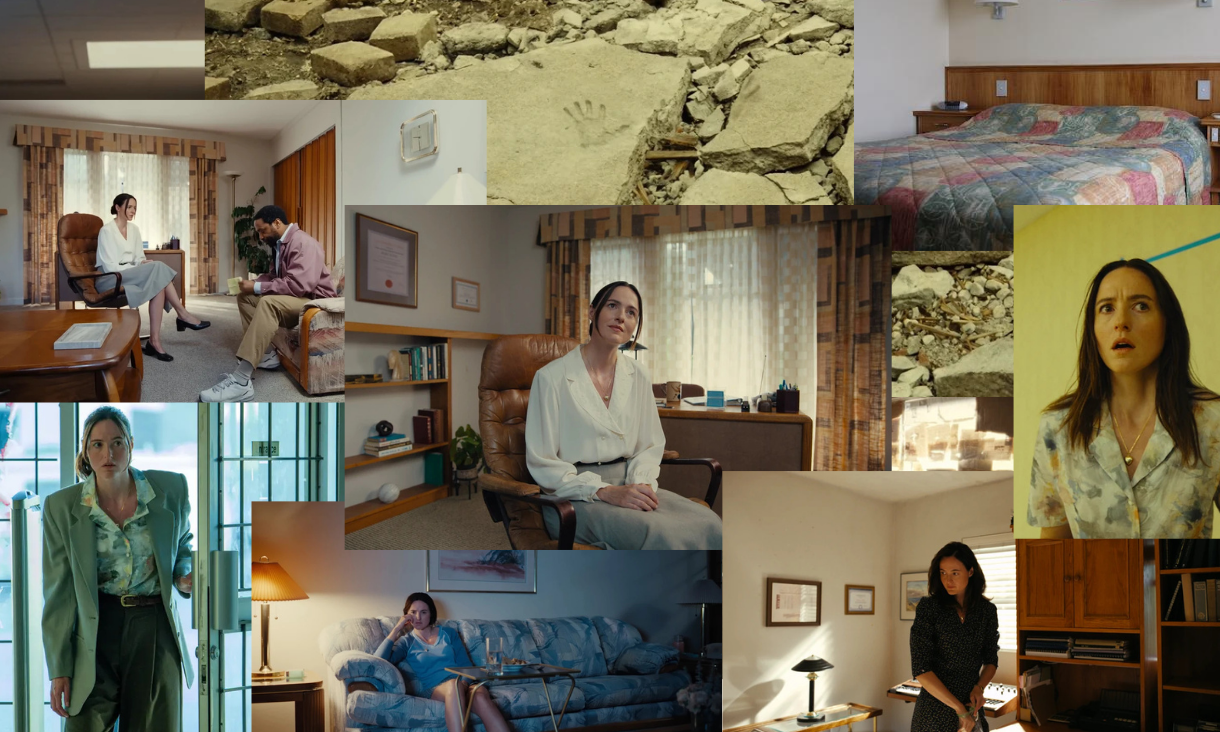
Dr Kline's environment (office, home, shirt) was characterised by muted, pastel-beige, blurry geometric patterns. There is little individuality; the selection looks as if it were picked out of a catalogue on the same day. For Kline, a successful adult with a devastating upbringing, it makes sense that she wouldn't have had anything given to her – confirmed in the opening as we see the housing complex she grew up in demolished. Any major furniture purchases would have been sourced when required, leaving her to choose from the trends of the time. Her choices lean sensible, almost bland. Despite the normalcy-camouflage, we still witness her struggling to connect with the people around her.
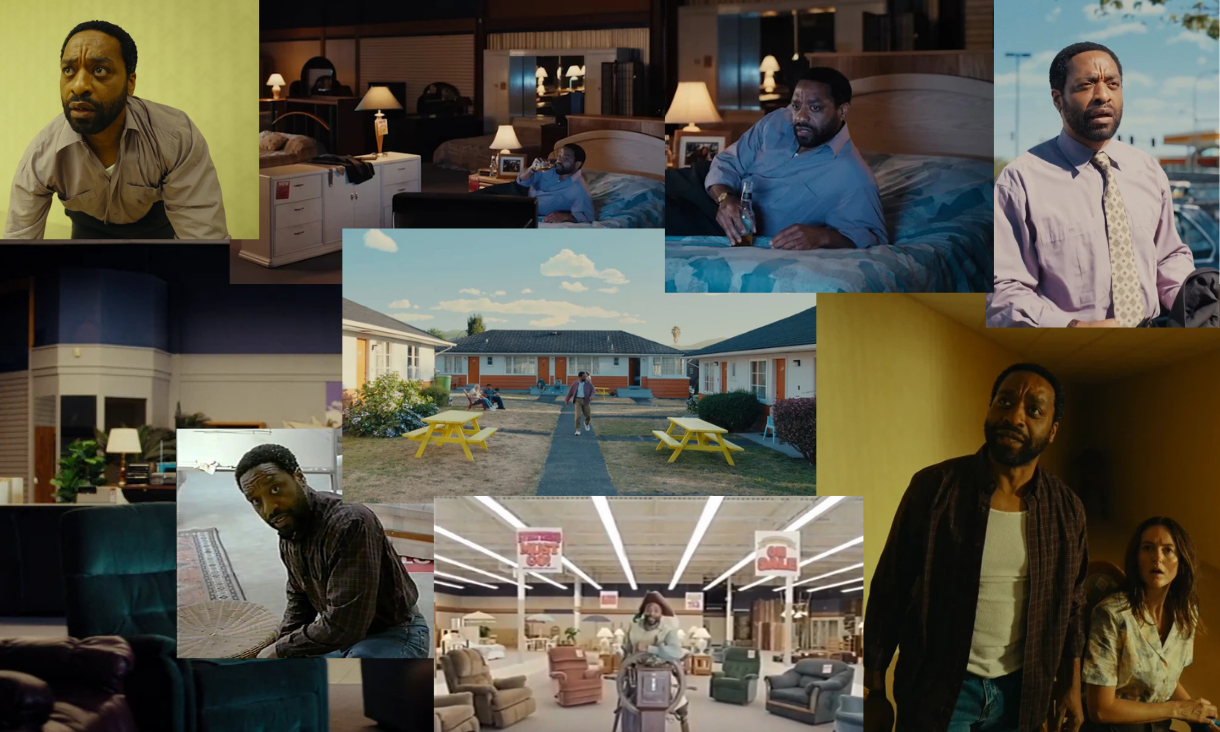
Up the production pipeline [from catalogue to distributor], we have Clark. His clothing (pirate costume aside) sticks to a conventional formula of button-up shirt + pants. The individual items slide from business-like to blue-collar, reflecting his tug-of-war identity crisis between architect and furniture-outlet owner. He’d ticked off most of the American Dream: education, marriage, house in the suburbs, business owner, but remained on the outskirts of the community, saddled with a haunted inferiority complex.
Clark is the only Black character in the film, and his spiral could be viewed, in part, as the effects of structural violence. After splitting from his wife, he moves out of their suburban abode and into his workplace––a fluorescent-filled big-box store. Both structures were popularised during the post-WW2 suburban sprawl, a period of racist, economically inefficient, and isolating city planning, which historian and philosopher Lewis Mumford described as "an asylum for the preservation of illusion." Suburb-supporting zoning laws prohibited basically anything other than single-family dwellings, driving up land costs and pricing out lower-income home buyers. This also meant small businesses couldn't thrive, and bigger retailers (box stores) were primed and ready to eat up the minimal space allocated for commercial use.
The suburban sprawl was built upon the segregatory effects of redlining, ensuring that post-Depression, only white families were able to achieve homeownership [anyone else was marked as unsafe to insure]. These effects, combined with predatory legislation and systemic oppression (plus widespread cultural terrorism), made sure that when the American Dream was pitched, it was whites only. Clark has been fucked over; he's never going to achieve the American Dream because it wasn't created for him. Instead, he's forced to watch from the outside, helping a community he'll never be part of furnish homes he's not allowed to live in.
Kline’s catalogue-selected surroundings and Clark's empty furniture store are grim conveyor-belt environments. Both characters exist in spaces designed for an assigned role––as opposed to someone they get to be. As the characters either leant into or fought against them, the spaces shift, but ultimately, neither Kline nor Clark really escaped the forces controlling their environment. Depressing. SADD.
The concept of a space pre-determining the interactions of the people within it feels more nefarious than just good user design. Good user design is offering up a bench to sit on; a predetermined interaction is offering up a bench with divided seating. Both give you a place to sit, but only one has been hijacked by a moustache-twirling villain who gets hot for defensive architecture.
Display homes, empty airports, stores with hungrily attentive staff and body-changing mirrors—all unsettling. The emptiness reveals a type of commercial manipulation that’s harder to see when accompanied by bustle; my presence feels anticipated by something unseen and therefore surveilled. The eeriness becomes especially noticeable when the space lacks the reciprocal relationship of the people it was made for.
Hotel Urashima is like if a James Bond villain modelled their lair after the resort in Dirty Dancing. It sits alone on an island in Katsuura and is inspired, I assume, by the concept of someone crashing a cruise ship into a shoreline. Blocky, white, many-windowed buildings push into the rock face, connected through a complicated and frankly unnecessary series of tunnels and lifts. The interior is retro—lots of columns, wooden panelling, gold and blush-pink dining chairs, a patchwork of marble flooring, high, well-lit ceilings, and vintage wayfinding signs. We (two friends and I) had booked in to stay post-hike. Upon arrival (turtle-shaped ferry), we tried to find a restaurant for dinner, but were told there was only one available (expensive, very).
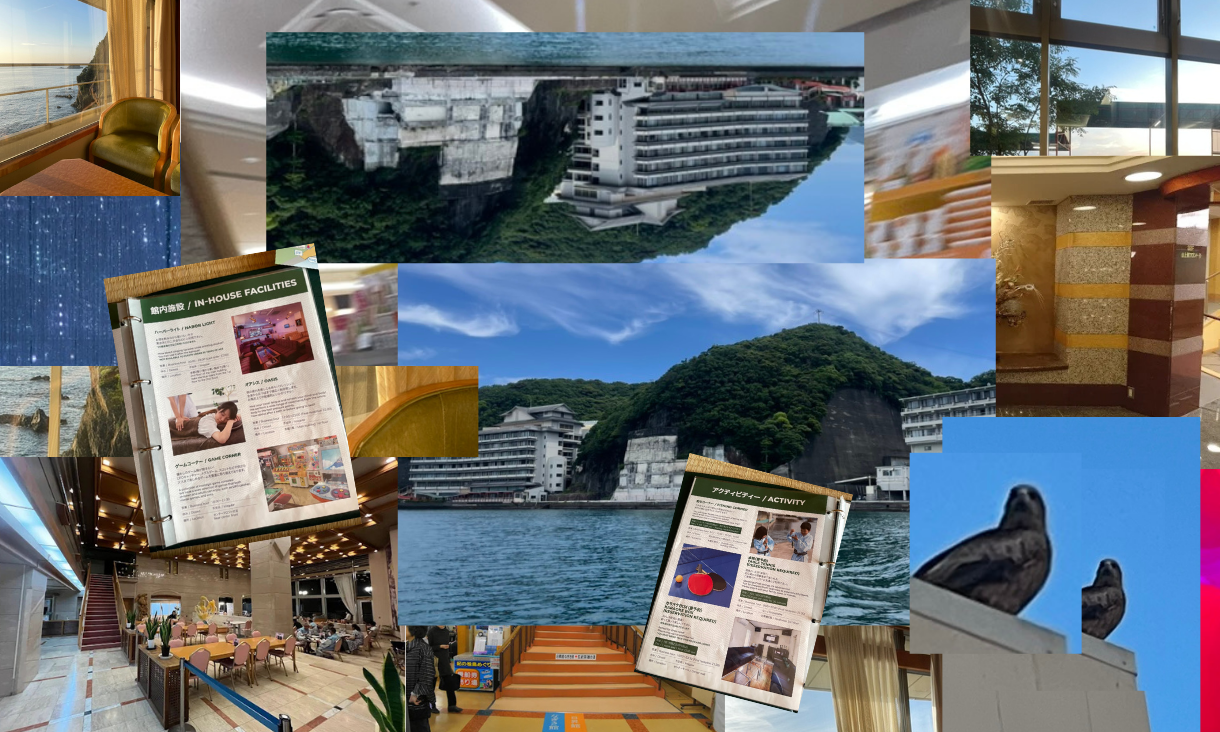
We'd encountered few guests and many eating areas, allegedly all booked out. Rejected and disoriented, we wandered through the hotel. The tunnels were large and lined with pop-up souvenir shops or tourist information desks. The hotel (now cemented in my mind as a living evil with a monopoly on food) was offering us every mall-adjacent tourist experience imaginable: retail stores, massages, an arcade, karaoke, fishing, reservation-only table tennis—the list of things we didn't participate in goes on. We assembled a gift shop dinner and tried to eat outside (hawks will attack for orange juice, you’ve been warned).
The rooms were beautiful, the views were glittery, and the cave onsen was mwah, but stepping into any other space made me tight-muscled and frenetic, a feeling I’d forgotten until I saw Backrooms and was reflung into architectural uncanny valley. Historian Anthony Vidler coined that phrase to describe the alienating effects of commercial modernism, arguing that it appears in benign spaces so utterly reproducible that they end up belonging to no one. Fitting, as this type of bubble-era megacomplex popped up in Japan due to post-WWII Americanisation, the 1964 Olympics, and good ol' corporate grind.
After WW2, US forces occupying Japan made repairing the railways a top priority, and the servicemen stationed there created a demand for Westernised accommodation (hotels with bars and lobbies). The transport infrastructure enabled newly connected rural areas to try to rebuild their economies by attracting the wealth of soldier-tourists. Western-style buildings began cropping up along coastlines and in areas the US military had co-opted. Plans to modernise the nation's transport network beyond military needs were already underway, but they accelerated once Japan became the first Asian country to win an Olympic bid. The 1964 Games marked Japan's cultural re-emergence; it was time for them to exhibit their remarkable economic recovery and cement their reputation as a modern innovator (see: newly unveiled bullet train).
So, you've just connected your city hubs to your rural recreation towns; who do you send on holiday first? The tired white-collar workers, who'd been propping up the economy. Salaryman culture meant work was also your social life. The shain ryoko [a concept no longer en vogue] was a group-harmony-themed vacation where you and 100-odd colleagues went away and became a corporate amoeba. You arrived together, ate together, and celebrated together. This type of simultaneous group-migration requires a lot of space, and so arrived the megacomplex.
Around the same time, a purposeful weakening of the US dollar through the 1985 Plaza Accord sent the yen soaring, which made the Bank of Japan slash interest rates to protect exporters. The banks handed out bucketloads of cash, and the government introduced tax incentives that favoured large developments (see: 1987 Resort Law), meaning these types of structures began to multiply. A few years later, the stock market, the real estate bubble and the appetite for huge hotels came crashing down. They were expensive to run, and an economic downturn means fewer tourists; demolition costs money, vacant land gets taxed at a higher rate, and if the original developer's company went bankrupt (often), there was no single entity left with the authority, or the funds, to make a call. Buildings were left to become haikyo (urbex dreamscapes).
Urashima isn't haikyo, but it might have seemed more at peace if it was. It felt caught in the irreversibility of time, and because of this, fundamentally unsettled and cold.
I don’t know what the essentials of being human are, or if an essential human experience even exists. Most days I don’t mind monitors, and I do think the internet was better when it was more prone to traumatising me. My house has possums living in the walls, my bedroom door is glass, and if I was a monkey, a scientist would probably watch me starve to death while clinging to a blanket.
Also, I hated Backrooms.